
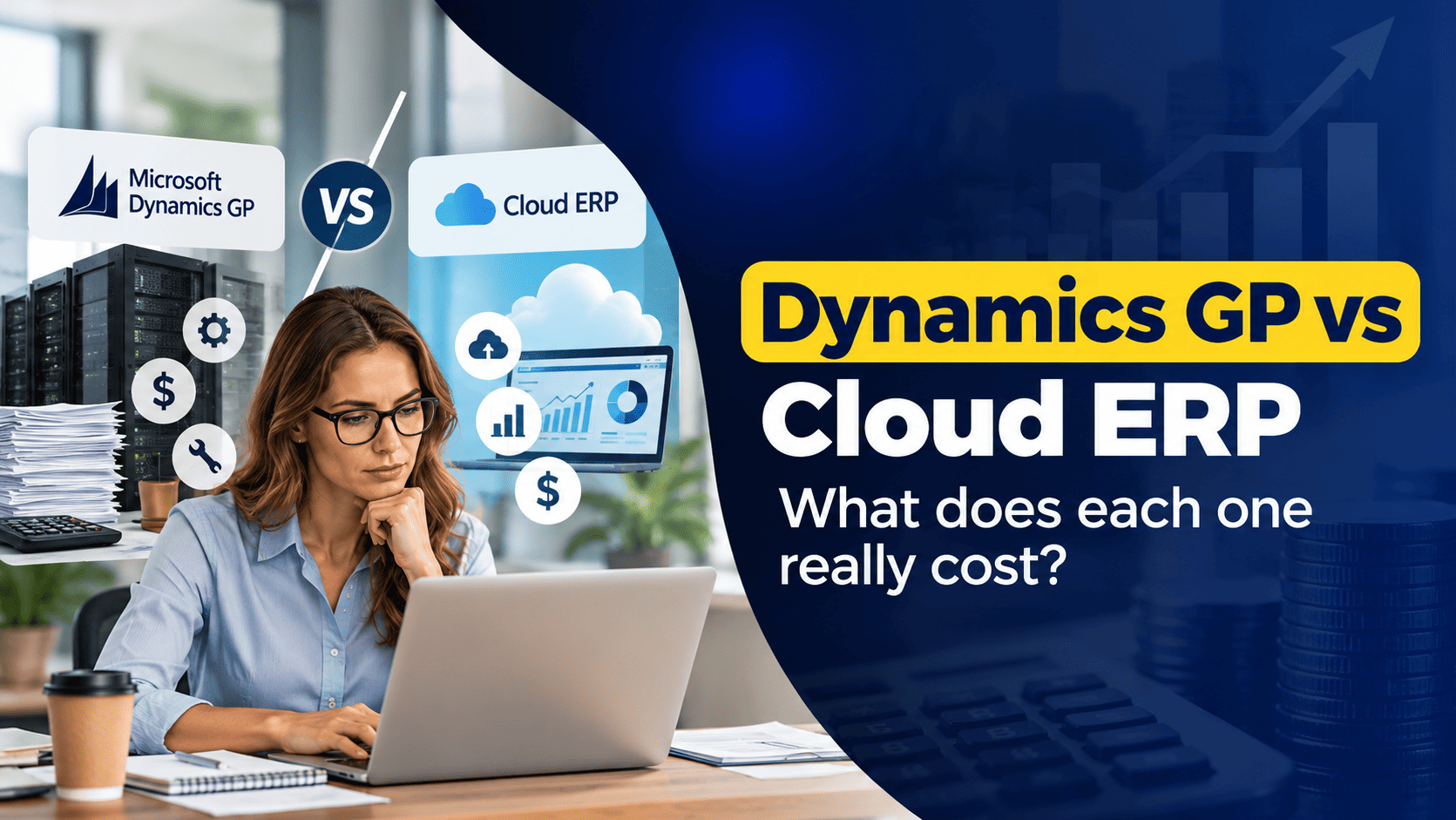
When finance leaders compare Dynamics GP with a cloud ERP, most start with the license line. GP looks cheap, because the licenses were paid for years ago. A cloud system looks expensive, because it charges a fee for every user, every month. On that basis, staying on GP seems like the careful choice.
The problem is that the license is only one line in a much longer list. Microsoft Dynamics GP (Great Plains) also needs servers, database software, backups, remote access, upgrades and people to look after all of it. A fair comparison counts every one of these.
That full count is called total cost of ownership. In this article, we go through the costs using current 2026 figures and compare GP with Business Central.
What is Total Cost of Ownership (TCO)?
Total cost of ownership is everything you spend on a system from the day you buy it to the day you replace it.
Think about owning a car. The purchase price is only the beginning. Over the years you also pay for fuel, insurance, servicing and repairs, and those costs often add up to more than the car itself. Software works the same way.
For an ERP system, the costs fall into three groups:
- Costs to get it: licenses, implementation, data migration and training
- Costs to run it: maintenance plans or subscriptions, servers or hosting, supporting software, backups, security and IT time
- Costs to change it: upgrades, rework of customizations, new integrations and, in the end, replacement
Most businesses measure TCO over five years. For GP users, that period matters more than usual. Microsoft ends product and tax updates for GP on December 31, 2029, and security updates on April 30, 2031. Any five-year view starting today reaches those dates, so the cost of replacing GP belongs in the calculation now. Our guide to Dynamics GP end of support explains the timeline.
TCO of Dynamics GP vs Cloud Solutions
What GP costs to run
The largest visible cost is the annual maintenance plan. To receive updates and support, GP customers pay for an Enhancement Plan or an Advantage Plan, priced as a percentage of license value. That percentage has gone up several times:
| Period | Enhancement Plan | Advantage Plan |
|---|---|---|
| Before 2022 | 16% | 18% |
| From October 2023 | 18% | 20% |
| From October 2025 | 20% | 22% |
A full GP user is commonly quoted at about $3,000 at list price. At today’s rates, that is $600 to $660 per user per year, or $50 to $55 per month, for a product that no longer receives major new features.
On top of the plan, GP brings costs that are easy to miss:
- Servers or hosting: your own hardware, or a monthly bill for virtual machines
- Supporting software: Windows Server, SQL Server, backup, security and remote access tools
- IT time: patching, backups, user access and troubleshooting
- Upgrades: each version upgrade needs consultant time, testing and some downtime
- Add-ons: third-party products with their own annual renewals
What the cloud costs to run
With Microsoft Dynamics 365 Business Central, most of those lines are replaced by a single subscription. Current US list prices are $80 per user per month for Essentials, $110 for Premium and $8 for Team Member.
That subscription includes hosting, backups, security and two major updates a year, all managed by Microsoft. It does not include implementation, add-on apps or partner support. For a full breakdown, see our Business Central pricing guide.
Cost of staying on GP vs migrating to a Cloud Solution
It would be misleading to say that moving to the cloud is cheaper from the first day. A migration has real upfront costs: implementation, data migration, testing and training. In the first year, moving almost always costs more than staying.
What matters is how the two paths behave over several years.
If you stay on GP, your costs begin lower but keep climbing. The maintenance percentage has been rising, servers need replacing, and each upgrade brings a sudden extra cost. At the end of the path, you still have to replace Microsoft Dynamics GP (Great Plains).
If you move to Business Central, you pay the project cost at the start. After that, your spending becomes steady and predictable, with no server replacements and no upgrade projects.
This leads to the point we most want to emphasize. Staying on GP does not remove the migration cost. It only moves it to a later year. So the true comparison is:
- Path A: run GP for a few more years, then pay to migrate
- Path B: pay to migrate now, then run Business Central
Once the migration cost appears on both sides, the question becomes simpler: which system costs less to run each year?
TCO of Dynamics GP vs Business Central
Here is a simple worked example for a business with 20 full users. The figures use list prices, so treat them as an illustration, not a quote.
| Calculation | Yearly Cost |
|---|---|
| GP Enhancement Plan 20 users × $3,000 × 20% |
$12,000 |
| GP Advantage Plan 20 users × $3,000 × 22% |
$13,200 |
| Business Central Essentials, list price 20 users × $80 × 12 |
$19,200 |
| Business Central Essentials, with a 30% discount 20 users × $56 × 12 |
$13,440 |
Looking at this table alone, GP is cheaper by $7,200 a year at list price. This is where many comparisons stop, and it is why GP appears to be the low-cost option.
Now add the GP costs that the Business Central subscription already includes: servers or hosting, SQL Server and Windows Server licenses, remote access, backups, IT time and upgrade projects. If these add up to more than $7,200 a year, which is only $600 a month, Business Central already costs less to run than GP in this example. For most businesses, hosting and IT time alone go past that amount.
Two more points can improve the picture:
- Not every user needs a full license. People who only view reports or approve documents can use the $8 Team Member license.
- Microsoft offers migration discounts. Under the current Bridge to the Cloud 3 promotion, eligible GP customers can receive around 30% off, which brings Essentials close to $56 per user. Eligibility depends on your licensing, so check before you plan around it.
Optimize your ERP investment with Nevas Technologies
Every GP system is different, so a general example can only take you part of the way. Nevas Technologies has worked with Microsoft Dynamics for more than twenty years, and we help GP customers build a cost comparison based on their own numbers.
Here is how we support you:
- TCO review: We gather your real GP costs and compare them with Business Central over five years.
- Evaluation: We help you recognize which GP customizations and add-ons you still need, and which are covered by standard Business Central features.
- Migration: Our Dynamics GP to Business Central migration service covers discovery, data migration, testing and training.
- Clear pricing: Our Business Central implementation plans show scope and starting prices.
- Ongoing support: We stay with you after go-live.
Our aim is to give your organization a clear, honest set of numbers, even when they show that waiting a little longer makes sense for you.
Next steps
Summarizing the main points: the license line makes GP look cheaper than it is, the maintenance percentage keeps rising, and the cost of replacing GP cannot be avoided, only delayed.
Here is what we suggest:
- Collect your real GP costs for the last 12 months, including servers, supporting software, IT time, upgrades and add-ons.
- Count your users by type, so you know how many need a full license.
- Check your eligibility for Microsoft’s current migration discount.
- Build a five-year comparison with the migration cost included on both paths.
Want help analyzing your numbers? Talk to our Business Central consultants and we will prepare a TCO comparison for your business.
Frequently Asked Questions
Is Dynamics GP cheaper than Business Central?
On license fees alone, often yes. Once you add servers, supporting software, IT time and upgrades, GP usually costs more to run each year.
How much does the GP Enhancement Plan cost in 2026?
Since October 1, 2025, the Enhancement Plan is 20% of your license value per year, and the Advantage Plan is 22%.
How much does Business Central cost per user?
US list prices are $80 per user per month for Essentials, $110 for Premium and $8 for Team Member. Eligible GP customers may qualify for a discount.
Does moving to the cloud always lower TCO?
Not in the first year, because of the migration project. Over several years it usually does, but the result depends on your users, infrastructure and add-ons, so it is worth calculating for your own case.