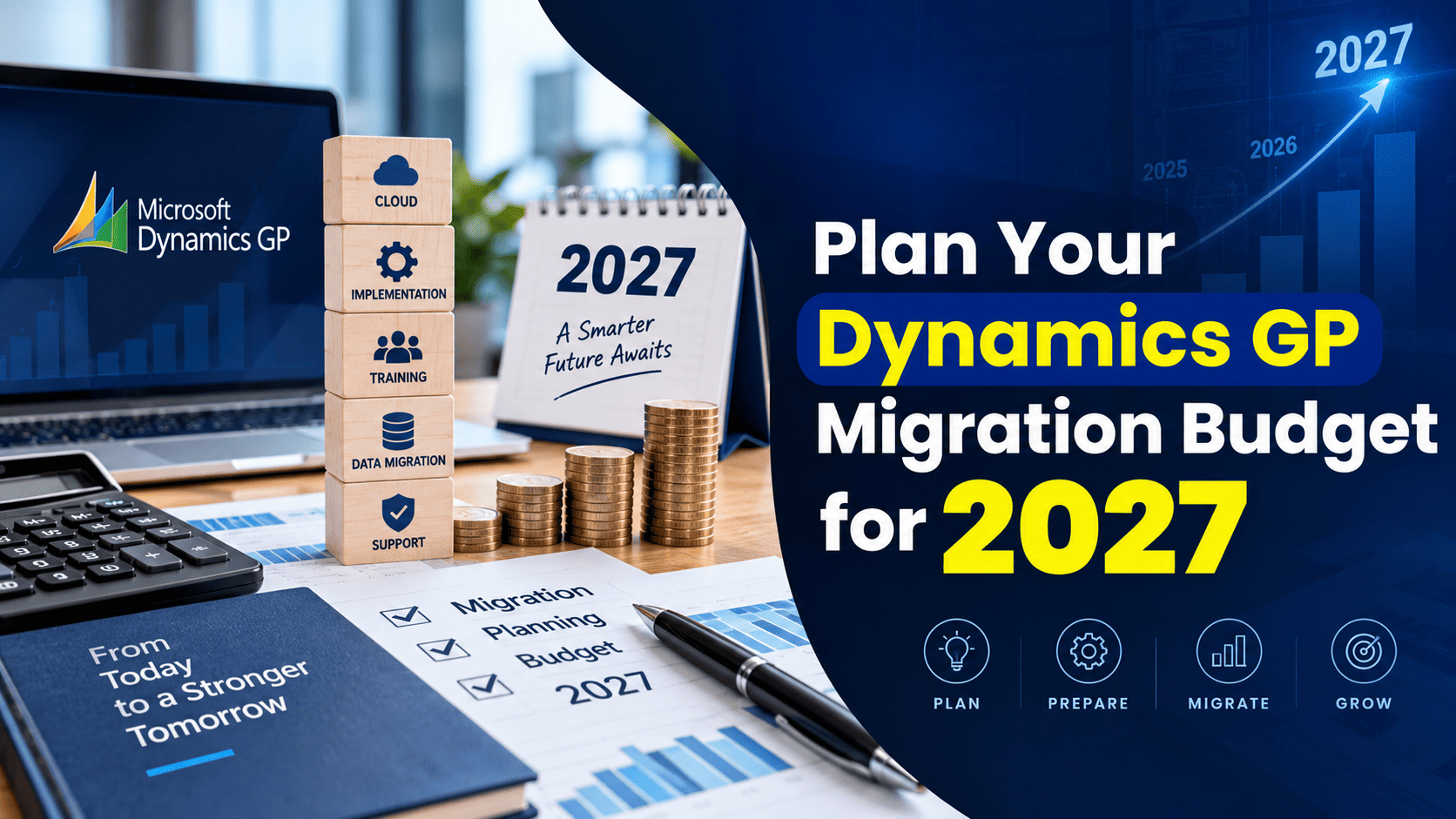

Most Dynamics GP migrations don’t go wrong because the destination platform was the wrong choice. They go wrong because the budget was built on guesswork rather than a proper look at the environment being replaced. With Microsoft’s support timeline for Dynamics GP now clearly in view, running through 2029 for core support and 2031 for final security updates, 2027 is a realistic year for many businesses to start turning migration planning into an actual line item. Here’s how to approach that budgeting properly, and where businesses most often trip up.
Why You Should Start Budgeting for 2027 Now
Waiting until a firm deadline forces the decision rarely produces a good budget. It produces a rushed one, put together under pressure with whichever numbers happen to be on hand. Starting the conversation in 2026, well ahead of a 2027 project, gives you room to compare quotes properly instead of accepting the first one under time pressure, and it gives your finance team a chance to plan the spend across a financial year rather than absorbing it as a shock in one quarter.
It also protects day-to-day operations. A migration planned calmly across 2026 and into 2027, with time to test properly in a sandbox before anything touches production, causes far less disruption than one squeezed into a narrow window because nobody started the conversation sooner. Teams that rush tend to skip the parts of a project that don’t feel urgent in the moment, like documentation and training, and those are exactly the parts that determine whether the new system actually gets adopted well once it’s live.
There’s also a funding angle worth factoring into your timing. Microsoft periodically offers incentives to businesses moving off legacy Dynamics products, and current programmes carry their own enrolment deadlines, some running only through the next couple of years. Those offers tend to shrink or close entirely as more customers act on them, and as more Dynamics GP customers approach the same 2029 support deadline at once, demand for migration partners is likely to rise too. A business that starts budgeting in 2026 for a 2027 or 2028 project is in a far better position to actually use an incentive while it’s available and to secure the migration partner and timeline it wants, rather than reading about a closed window or a fully booked consultant after the fact.
None of this requires you to have already chosen a platform, and none of it commits you to migrating this year. It just requires an honest starting point, which is exactly what a proper Dynamics GP support review of your current environment can give you, whether your target year turns out to be 2027, 2028 or later.
Avoid Common Mistakes in Your Migration Budget
A handful of mistakes show up again and again in GP migration budgets, and most of them are avoidable with a bit more upfront diligence, whichever year the project actually lands in.
Choosing a partner on price alone is one of the most common. The cheapest quote often assumes the simplest possible version of your environment, and the gap gets discovered mid-project, at which point it’s an unwelcome addition to the invoice rather than a planned line item.
Compressing the timeline is another. Migrations that are rushed to hit an arbitrary date, whether that’s a fixed 2027 go-live or an internal deadline set without much thought, tend to skip proper testing, and problems that would have been caught in a sandbox instead surface in front of your live users.
Skipping a real assessment of the current system is a third. Without a genuine look at your data, customisations and integrations as they stand today, any quote you receive for a 2027 or later project is really an estimate of an estimate, and estimates like that tend to grow once the real work begins.
Underestimating what happens after go-live rounds out the list. Training, data clean-up, and a stabilisation period where your team adjusts to new workflows all cost time and attention well into the months following launch, and none of it should be a surprise if you’ve planned properly from the start.
Ignoring how the timeline interacts with Microsoft’s own deadlines is a mistake specific to Dynamics GP right now. A project planned for late 2029, right up against the end of core support, leaves almost no room for delay. A project planned for 2027 or 2028 gives you a genuine buffer if something in discovery takes longer than expected.
Each of these traces back to the same root cause: not knowing enough about your own environment before pricing the move. That’s precisely what a structured Dynamics GP to Business Central migration plan is designed to fix, by mapping out your data, customisations and integrations before a single number goes on a quote. It’s also worth budgeting for what comes after go-live, not just the project itself. Ongoing Dynamics GP training or its equivalent on the new platform helps your team get comfortable faster, and a stabilisation period built into the plan for 2027 or whichever year you choose, rather than treated as an afterthought, tends to prevent small teething issues from turning into larger ones.
How a Nevas Technologies Assessment Can Help
Rather than asking you to price a migration in the dark, Nevas Technologies starts with a proper look at where you actually stand today, and what a realistic timeline into 2027, 2028 or beyond would involve.
We build a realistic, itemised budget based on your specific environment, not a generic industry average, so the number you plan against reflects your business rather than someone else’s, and reflects the actual year you intend to move.
We help you weigh your genuine options, whether that’s Dynamics 365 Business Central, Finance and Operations, or another platform entirely, based on your size, complexity and growth plans rather than a default recommendation.
We flag where Microsoft’s current migration incentives might reduce your cost, since these change over time, carry their own closing dates, and are easy to miss if nobody is actively tracking them for you across a multi-year planning window.
And we identify risk areas early, from undocumented customisations to integrations nobody remembers building, so they’re accounted for in the plan rather than discovered halfway through a project that’s already scheduled against a fixed 2027 or 2028 date.
Start Planning for Your Move Now
You don’t need to have picked a destination platform to start this conversation, and you don’t need to be migrating this quarter, next year, or even in 2027 specifically. What matters is starting from an accurate picture of your Dynamics GP environment rather than a guess, because that’s what turns a migration budget for any future year into a plan you can actually stand behind, rather than a number pulled together under pressure. Speak to the Nevas Technologies team about your Dynamics GP support and migration options, and get a clear, honest read on what your move would genuinely involve, whichever year you’re aiming for.