



For most companies leaving Microsoft Dynamics GP, the natural next step is Microsoft Dynamics 365 Business Central. It is Microsoft’s recommended path for GP customers, it has a dedicated migration tool, and it suits the size and shape of most GP organizations very well.
But not every Microsoft Dynamics GP customer looks the same. Some have grown far beyond the business Dynamics GP was originally installed for. They now run dozens of legal entities across several countries, deal with complex consolidations, or face regulatory demands that go well beyond standard accounting. For these organizations, it is worth asking a harder question: is Business Central really enough, or should we be looking at Dynamics 365 Finance?
In this article, we explain the difference between the two, the signs that you may need Finance, and how to make the decision without overspending or under-buying.
Why GP Customers Are Facing This Decision Now
Microsoft stopped selling Dynamics GP to new customers in April 2026. Product enhancements, tax updates and technical support end on December 31, 2029, and security updates end on April 30, 2031. Every GP customer will need to move at some point, and many are already planning.
The move is a rare chance to step back and choose a system for the next ten to fifteen years, not just to replace what you have today. That is why it is important to look at where your organization is heading, not only where it is now.
Understanding the Options
It helps to recognize what each system was designed for:
- Dynamics GP: An on-premises ERP built for small and mid-sized businesses. It is strong in core financials and has a wide range of add-ons, but it is reaching the end of its life.
- Dynamics 365 Business Central: Microsoft’s cloud ERP for small and mid-sized organizations. It covers finance, sales, purchasing, inventory, projects, service and manufacturing in one system, and it is quick to implement.
- Dynamics 365 Finance: Microsoft’s enterprise ERP for financial management, often paired with Dynamics 365 Supply Chain Management. It is built for large, complex and global organizations.
Both Business Central and Finance are part of the wider Microsoft Dynamics 365 family, run in Microsoft’s cloud and connect with Microsoft 365, Power BI and the Power Platform. The difference lies in depth, scale and complexity.
Where Business Central Fits Well
We want to emphasize this clearly: for the large majority of GP customers, Business Central is the right choice. It is a good fit when:
- You have one or a handful of legal entities, mostly in one or a few countries.
- Your user count is in the tens or low hundreds.
- Your finance processes are standard, even if they are busy.
- You want a faster, lower-cost implementation and a system your team can learn quickly.
- You prefer configuration and light customization through extensions over heavy development.
Business Central also supports multiple companies, multiple currencies, intercompany transactions and consolidation. Many organizations with several entities run it very successfully. You can see the full range of capabilities on our Business Central features page.
Signs Business Central May Not Be Enough
There are situations where Microsoft Business Central starts to feel stretched. Here are the signs we look for when analyzing a GP customer’s requirements:
- Many legal entities across many countries: If you operate dozens of companies, each with its own local tax, reporting and language needs, managing them separately becomes a heavy burden.
- Complex consolidation and eliminations: Multi-level ownership structures, partial ownership, frequent currency translation and detailed elimination rules point towards Finance.
- Shared services: If a central team processes payables, payments or collections on behalf of many entities, Finance is designed for that model.
- Advanced budgeting and planning: Organizations needing position budgeting, detailed budget control or rolling forecasts across many entities often need more than Business Central offers as standard.
- Heavy regulatory or public sector requirements: Detailed audit controls, segregation of duties at scale or industry-specific compliance may require enterprise-level functionality.
- Large and complex supply chains: Process manufacturing, advanced warehouse automation, multi-site planning or demand planning are areas where Dynamics 365 Supply Chain Management, alongside Finance, goes much deeper.
- Very high transaction volumes or user counts: Typically several hundred users or more working in the system at once.
If only one of these applies, Business Central with the right extensions may still be the better choice. If several apply, Finance deserves serious consideration.
What Microsoft Dynamics 365 Finance Adds
Compared with Dynamics GP and Business Central, Dynamics 365 Finance offers:
- Global scale in one system: Multiple country localizations working together with support for multiple languages and currencies.
- Advanced financial structures: Flexible financial dimensions, detailed posting rules and strong governance controls.
- Enterprise consolidation: Tools for complex group structures, currency translation and eliminations.
- Shared services: Centralized processing across legal entities.
- Budgeting and planning: Tools designed for large finance teams.
- Revenue recognition and subscription billing: Support for complex contracts.
- Deep integration: Connections with Supply Chain Management, Project Operations, Human Resources and Commerce.
In short, Finance is built for organizations where the finance function itself is large and complex, not just busy.
The Cost and Implementation Reality
This is where many organizations need to be honest with themselves.
License Costs Are Higher
At current list prices, a full Dynamics 365 Finance user license is around $210 per user per month, with a Premium edition at a higher price. Microsoft also requires a minimum of 20 full licenses for Finance. Users who need a second Dynamics 365 app can often add it at a lower attach price.
Business Central licenses cost considerably less, with no comparable minimum. You can compare the details on our Business Central pricing and licensing page.
Implementation Is Larger
A Business Central project for a GP customer often takes a few months. A Finance project usually takes much longer, involves more workshops, more design, more testing and a larger project team on both sides.
Ongoing Ownership Is Heavier
Finance typically needs more internal expertise or partner support to administer, update and extend over time.
Choosing Finance when you do not need it means paying more and waiting longer for capabilities you will not use. Choosing Business Central when you genuinely need Finance can mean a second migration a few years later. Neither outcome is good, which is why the decision deserves care.
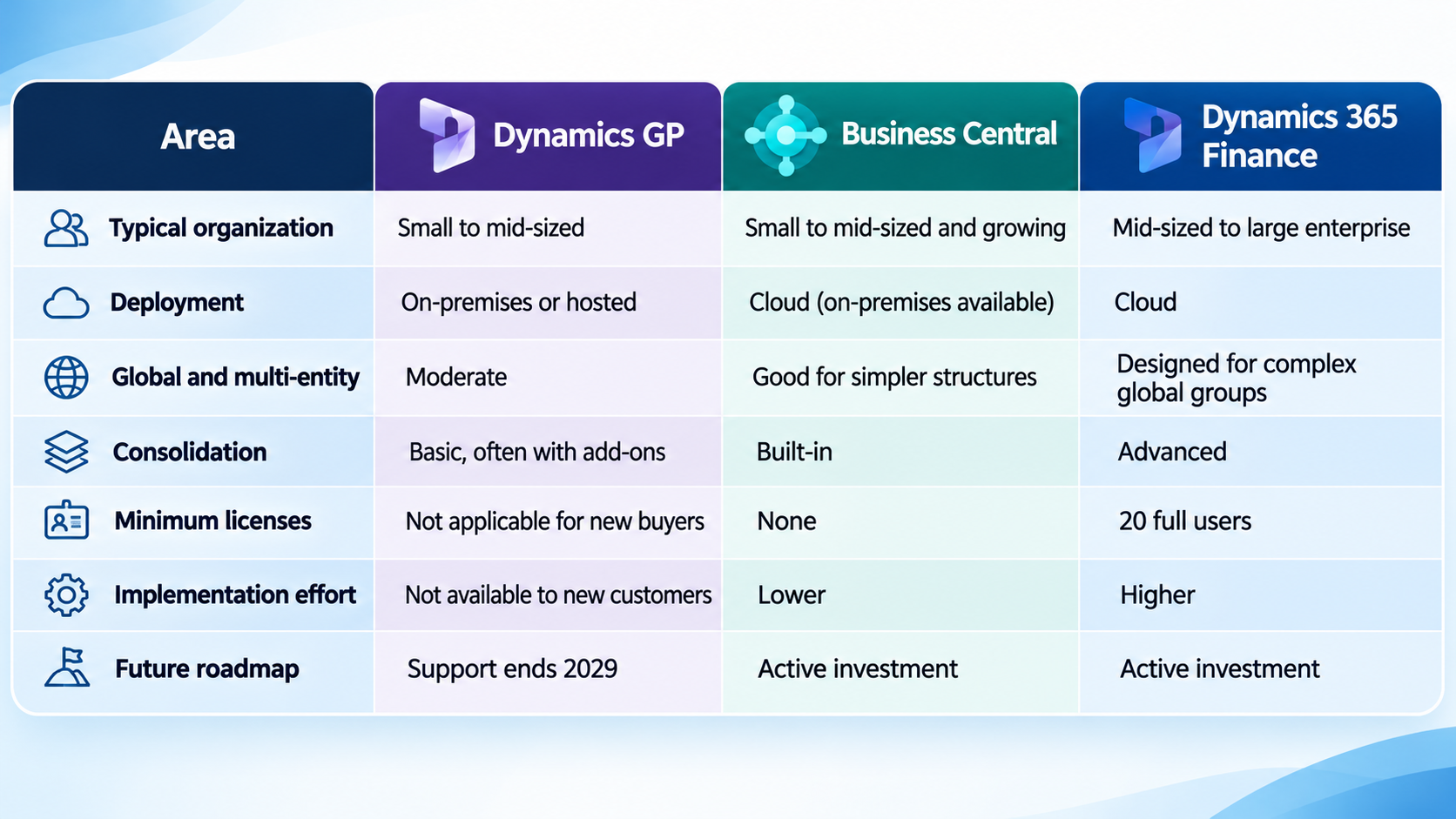
Dynamics GP vs Business Central vs Dynamics 365 Finance
How to Decide
When we help GP customers choose, we usually work through a few simple questions:
- How many legal entities and countries do you have today, and in five years?
- How complex is your consolidation and intercompany activity?
- How many people will use the system, and in what roles?
- Which processes are truly unique to your business, and which are standard?
- What budget and internal resources can you commit to the project and to running the system afterwards?
Summarizing the answers usually makes the right choice clear. Where it is not clear, a short discovery workshop and a demo of both systems will settle it.
Frequently Asked Questions
Can Dynamics GP data be migrated to Dynamics 365 Finance?
Yes, but Microsoft’s dedicated GP migration tool is built for Business Central. A move to Finance usually uses data migration templates and specialist tools, so it needs more planning.
Is Dynamics 365 Finance only for very large companies?
Not only, but it is designed for complex organizations. Mid-sized companies with many entities, international operations or demanding regulatory needs can be a good fit, even if their user count is modest.
What is the minimum license requirement for Dynamics 365 Finance?
Microsoft requires a minimum of 20 full user licenses for Dynamics 365 Finance. Business Central has no comparable minimum.
Can we start on Business Central and move to Finance later?
Yes, some organizations do. However, it is a separate implementation, so it is better to choose the right platform at the start if your growth plans are already clear.
How Nevas Technologies Can Help
At Nevas Technologies, we have more than two decades of experience with Microsoft Dynamics, including Dynamics GP, Dynamics 365 Business Central and Dynamics 365 Finance. We do not push one product over another. Instead, we look at your structure, your processes and your growth plans, and give you an honest recommendation.
Whether you choose Business Central through our Dynamics GP to Business Central migration service, or need the scale of Finance, our consultants and Dynamics 365 support team will guide you from planning to go-live and beyond.
Not Sure Which ERP System Fits Your Business?
Choosing between Dynamics 365 Business Central and Dynamics 365 Finance is an important decision for your organization’s future. Let Nevas Technologies help you evaluate your requirements and identify the right ERP solution.
Contact our team to schedule a demo, request a quote, or discuss your ERP requirements with our consultants.